"Clean sound isn’t sexy." (Firm!)
So far we’ve learned to clean sound—remove noise, tidy frequencies, make transparent space. (Sparkle!)
Yet the “warmth,” “thickness,” and “presence” in pro mixes comes from the opposite: making sound dirty. (Huh?)
That’s saturation. Today we explore why “distorted” can sound good.
1. The magic of harmonics: filling the spectrum 🪄
A pure sine wave sounds boring: “beep.” Add saturation and the waveform bends, creating harmonics.
- Original: 100 Hz
- After saturation: 100 + 200 + 300 + 400 Hz...
These added harmonics fill empty space. Even without raising peaks, the sound feels bigger, thicker, closer. That’s the “warmth” of analog gear.
2. Flavors of distortion (pick your taste) 🍦
Saturation comes in many flavors. Choose by context.
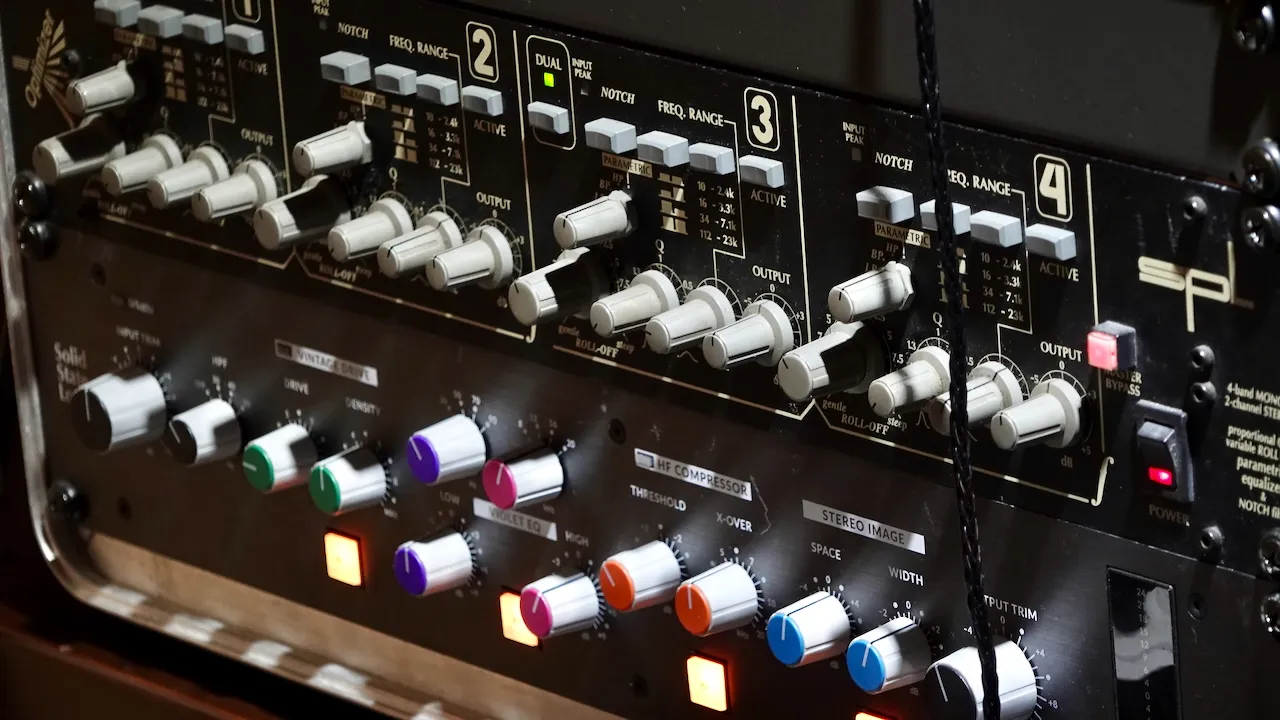
① Tube: “warmth” 🔥
- Characteristic: mostly even harmonics (2nd). Smooth and round.
- Use: vocals, bass, acoustic guitar. Great for warming cold digital sources.
② Tape: “glue” 📼
- Characteristic: softens sharp transients, tightens low end.
- Use: drum bus, master bus. Excellent glue for the whole mix.
③ Transistor: “aggression” 🥊
- Characteristic: strong odd harmonics (3rd). Hard and edgy.
- Use: rock guitars, snare, rap vocals. Shouts “I’m here!”
④ Bitcrusher: “destruction” 💥
- Characteristic: lowers digital resolution for gritty noise.
- Use: lo‑fi drums, dubstep bass.
3. Practical trick: make 808 audible on a phone 📱
A common beginner problem: “808 slams on speakers, but disappears on my phone!”
Why? Phone speakers can’t reproduce deep lows (<60 Hz). Turning up just makes it distort.
Solution: saturation
Drive the 808 with distortion or saturation to generate harmonics (200–400 Hz). Phones can play those mids, and our brains perceive “bass” from them. (Psychoacoustic trick!)
4. Warning: “Red lights mean stop.” 🛑
Analog gear can overload with pretty soft clipping. But digital clipping at 0 dBFS is just broken sound. (Crack!)
- Distort inside the plug‑in if you want,
- but keep the final output below 0 dB.
Summary
- Saturation adds harmonics by gently dirtying the sound.
- Harmonics make it feel louder without raising peaks.
- Flavor: Tube = warm, Tape = glue, Transistor = aggressive.
- 808 tip: saturation makes bass audible on small speakers.
A touch of dirt inside cleanliness—that’s the charm. (Sexy!) Now you control space, time, and color. Next we enter the art of automation, the dance of mixing over time.
[Common Beginner Mistakes] 🌋
- "Just dirty noise": too much saturation destroys the original tone. Keep the character, just add texture.
- "Confusing with digital clipping": pushing the master into red isn’t art. It’s an accident.
- "Distortion on everything": if all sounds are rough, ears get tired. Contrast is what creates presence.