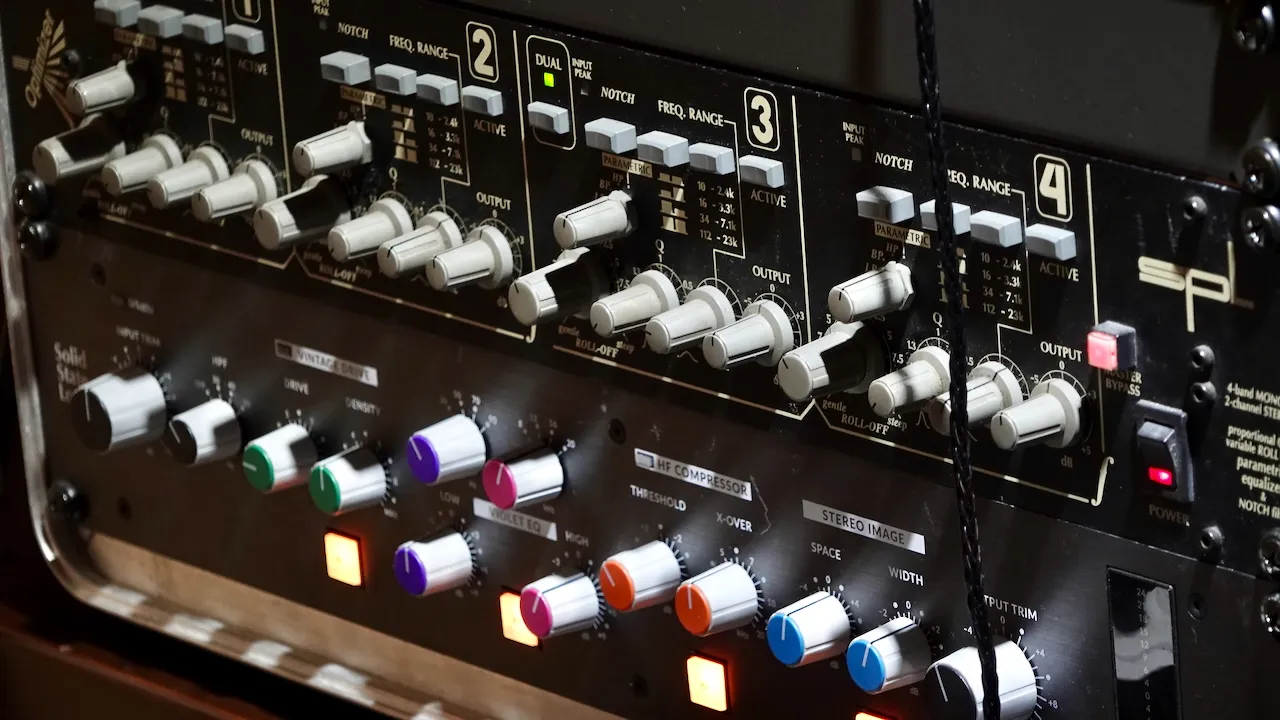
"Compressors are the hardest. I can’t hear what’s changing." (Grr.) Many people get stuck at the compressor. It doesn’t change sound as dramatically as EQ, and used wrong it just makes things dull.
But the principle is simple. Don’t overthink it. "When the sound gets too loud, it automatically turns it down."
That’s it. Really.
1. The big four compressor terms
If you understand these four, compressors become your toy. (Play time!)
- Threshold: “Cross this line and you’re in trouble!”
- The level where compression begins. Lower = more compression more often.
- Ratio: “How hard do we press?”
- How much to reduce once above threshold.
- 2:1: gentle tutor (vocals, acoustic)
- 4:1: firm teacher (bass, snare)
- 10:1: strict drill sergeant (peak control, limiting)
- Attack: “How fast do we hit?”
- Fast: clamps immediately, making the sound rounder and pushed back.
- Slow: lets the initial transient through, keeping punch. Essential for drums.
- Release: “When do we let go?”
- The time it takes to return to normal. This creates groove. Let the needle dance with the tempo.
2. Why compress? (The paradox)
"I want it bigger—why are we making it smaller?" (Hmm.) This is the core paradox of compression.
- We push down the loud parts.
- The dynamic range shrinks and the sound becomes consistent.
- Then we turn the whole thing up (make‑up gain).
- Result: quiet parts get louder, loud parts get controlled, and the sound feels thicker, tighter, fuller.
That “forward” energy in modern music is built on this process.
3. Watch the GR meter
If you can’t hear it, look at the gain reduction (GR) meter. When it drops, the compressor is telling you “I’m reducing this much.”
- Just cleaning up: move around ‑2 to ‑3 dB.
- Tight control: hit ‑5 to ‑10 dB boldly.
- Combine ear training with meter watching to learn fast.
4. Advanced trick: parallel compression
"Compression makes it tight but kills life." (Dull.) Use parallel compression (NY style).
- Duplicate the drum track (or send it to a new channel).
- On the copy, apply heavy compression (Ratio 10:1+, GR ‑10 dB+). Smash it. (Kaboom!)
- Blend the clean (dry) track with the smashed (wet) track.
This keeps the punchy transient from the dry track and adds density from the compressed track. Two birds, one stone. (Yes!)
Compression is closer to a physical feeling than a sound change. Feel the density shift—the loose sound tightens, the rhythm grooves. (Tight!)
[Common Beginner Mistakes] 🥊
- "The needle isn’t moving": Threshold is too high, but you still think it sounds better. Check the GR meter first.
- "Choking everything": Ratio 10:1 on every track kills dynamics. If it feels like the mix can’t breathe, check release.
- "Ignoring attack": Fast attack kills drum punch. If drums disappear, slow the attack. (Gentle!)